

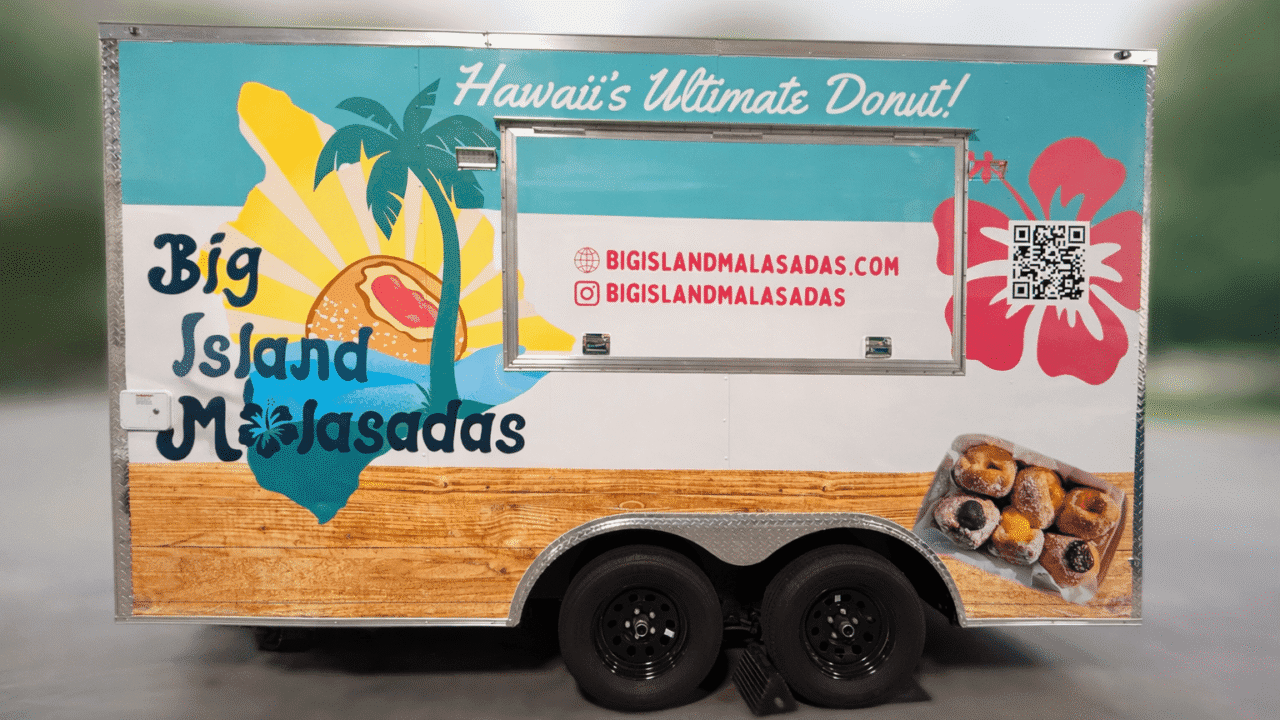
You’ve got less than three seconds. That’s roughly how long a passerby spends looking at your food truck before they decide whether to stop or keep walking. In that window, your wrap needs to tell them who you are, what you’re serving, and why they should care all before a single word is spoken. The food truck owners who understand the difference are the ones with the longest lines.
The temptation when designing a food truck wrap is to include everything. Your name, your full menu, your phone number, your hours, your Instagram handle, your origin story. It feels like more information equals more opportunity. But a wrap that tries to say everything ends up saying nothing.
Clutter doesn’t communicate. It’s overwhelming.
The best food truck wraps are the result of deliberate decisions: what stays, what goes, and what belongs somewhere else entirely. This guide will walk you through each of those decisions so that every element on your truck earns its place and does its job.
The Three Things Every Food Truck Wrap Must Communicate
Before anything else goes on your truck, three elements need to be locked in and designed to dominate: your business name, your logo, and a clear signal of what you sell.
These are branding basics, and they’re the foundation that every other design decision is built around. They need to work together to create an identity that registers instantly, even at a glance from across a parking lot.
1. Business Name: Make It the Headline
Your name needs to be large, legible, and visible from a distance. This sounds obvious, but it’s one of the most commonly compromised elements in food truck wrap design. Fonts get chosen for personality over readability. Names get tucked into corners or scaled down to make room for other elements. The result is a truck that looks busy but doesn’t stick.
Think of your name as the headline of an advertisement. It should be the first thing a stranger reads, and it should be readable from at least 50 feet away in full daylight.
2. Logo: Design It for Scale
A logo that works beautifully on a business card or app icon doesn’t always translate directly to a large-format vehicle surface. Scaling up reveals weaknesses in design, thin lines disappear, fine details blur, and colors that look sharp on screen can shift dramatically in print.
Before your wrap goes to production, make sure your logo has been evaluated and prepared specifically for large-format use. A great wrap designer will flag these issues early and work with you to adapt your logo without compromising its integrity.
3. Cuisine Type or Tagline: Answer the Question Before They Ask It
If your business name doesn’t immediately communicate what you serve, you need a supporting line that does. Customers make split-second decisions. If they can’t tell within one second whether your truck is selling tacos, BBQ, or Thai food, they may not bother finding out.
This doesn’t have to be complicated. Sometimes it’s as simple as a cuisine descriptor beneath your name, or a tagline that does double duty by communicating both what you sell and your brand personality. A line like “Wood-fired pizza, made to order” tells a customer everything they need to know to decide whether to get in line.
Social Media, QR Codes, and Contact Info: What to Include on Your Food Truck and Where to Put It
Once your core identity is established, the next layer to consider is how your wrap connects customers to your brand beyond the moment they see your truck. Digital touchpoints, such as social handles, QR codes, and web addresses, can extend a single visual impression into a lasting customer relationship.
Social Media Handles: Promote Only What You Maintain
Your social media presence is where customers go to check your schedule, see your menu, get excited about your food before they arrive, and share their experience after they leave. Including your social handles on your wrap is one of the smartest things you can do, but a few rules apply:
- Only include platforms where you are consistently active. A handle that leads to a dormant account does more harm than good.
- For most food trucks, Instagram and TikTok are the highest-value platforms to promote. Focus there, if you’re active on those platforms.
- Display handles cleanly, with the platform icon for instant recognition.
- Place them where they’re visible when your truck is stationary and serving customers. Customers are most likely to notice your social handles while they are waiting in line or waiting for their order.
QR Codes: One Code, One Purpose
A QR code on your food truck wrap can be genuinely powerful, but only if it has a single, clear destination. Pick one action that matters most to your business and makes the most sense for your customers right now, whether that’s viewing your menu, placing an order online, or leaving a Google review. Placing multiple QR codes on a single wrap can create confusion and dilute the action you actually want customers to take, so choose only one.
Place your QR code at eye level on the side of your truck nearest to where customers queue or wait. This is the moment they’re most likely to have their phones out. Label the code clearly so customers know exactly what they’ll get: “View our menu” or “Order ahead” works far better than an unlabeled code that nobody bothers to scan.
Website and Phone Number: Make them Count or Leave Them Off
Website and phone numbers earn their space on some food truck wraps while simply adding clutter to others. If your website is where customers place orders, check your schedule, or find your location, include it. If it’s a rarely-updated placeholder, leave it off.
Phone numbers are worth including if customers regularly call ahead or if you take catering inquiries. Otherwise, they take up visual real estate that could be better used.
The guiding principle for every digital element: it should have one clear purpose. If you can’t articulate what action you want a customer to take after seeing it, it probably doesn’t belong on the wrap.
How Should You Display Your Menu on Your Food Truck?
Menus change. Prices change. Items get added, removed, and seasonally rotated. When it comes to your truck’s menu, a little strategic thinking ahead of time can save future expenses and a lot of visual noise, making your food truck’s menu work best for your customers and your business.
A signature item, a hero food image, a cuisine category, or a “house specialty” callout on your wrap can whet a customer’s appetite without overwhelming the design or boxing you in. Meanwhile, your full menu should be approached with flexibility in mind.
Food Truck Menu Boards and Temporary Graphics
Your vehicle wrap is not your only graphic surface, and it shouldn’t be trying to do every job on its own. Purpose-built temporary graphics are the perfect solution for communicating your current menu, pricing, and daily specials. Options include:
- Printed menu boards mounted near your service window
- Magnetic panels that can be swapped out seasonally or as your offerings change
- A-frame sidewalk signs that draw in foot traffic from a distance
- Window clings for specials, LTOs, or pricing updates
These options are changeable, affordable to update, and designed to be read up close by customers who are already interested and standing in line.
This two-layer approach, a permanent wrap that attracts customers, paired with flexible temporary graphics that inform and sell, is the most effective system a food truck can use. It keeps your truck looking sharp and current without the cost of a full rewrap every time your menu evolves.
When these two layers are designed together with a consistent visual language, the result feels intentional and professional. When they’re designed separately or treated as afterthoughts, the mismatch shows.
How to Design a Food Truck Wrap That Gets Shared on Social Media
Here’s something worth thinking about: the time customers spend waiting in line for their food is some of the most valuable real estate you have. They’re standing still. They’re looking at your truck. And they have their phones in their hands. That is an important opportunity for your business, and you can capitalize on it using your truck wrap.
Think of Your Food Truck as a Photo Backdrop
Encourage interaction and social sharing by giving customers a visual element so striking, clever, or personality-driven that people are compelled to stand in front of it and take a picture.
This could be a bold graphic that frames a person perfectly when they stand in front of it. It could be a mural-style illustration that feels like public art. Whatever it is, it should feel like something worth sharing, not something that looks like an ad.
The key distinction is designing for the person in the photo, not for your brand. The best shareable moments make the customer look good, feel something, or be part of something visually interesting. Your branding is there, but it’s woven into the scene rather than plastered over it.
Turn Every Customer Photo Into Free Advertising
When you design a shareable moment into your wrap, make sure your social handle is integrated naturally into that same zone. When a customer posts a photo in front of your truck, every person who sees that post should be able to find you with zero effort.
This turns every organic social post into a referral. Not because you paid for it, asked for it, or ran a contest, but because you built a wrap that was worth posting about in the first place.
What NOT to Put on Your Food Truck Wrap
Knowing what to exclude is just as important as knowing what to include. Here are the most common elements that food truck owners feel compelled to add but are almost always better left off.
- Your hours. They change. They vary by event and season. Put them on a temporary window cling, and your social profiles and website where they can be updated in real time.
- Your full address or home city. Food trucks move. A fixed address on a permanent wrap can confuse customers and looks outdated the moment you expand your territory.
- Long taglines or mission statements. If it takes more than five words to say, it’s too long for a vehicle wrap. Copy that works in a brochure rarely works at 35 mph.
- Too many menu items. As covered above, this belongs in your temporary graphic layer, not baked into your vinyl.
- Decorative elements that compete with your core identity. Every graphic element should support the visual hierarchy, not fight it. If something doesn’t help direct a viewer’s eye toward your name, your cuisine, or your call to action, it’s adding noise.
The one-second rule is a useful test. If a stranger driving past your truck can’t grasp your brand identity and what you sell within one second, something needs to come off. Simplicity isn’t a design limitation. It’s the goal.
Every Inch of Your Food Truck Wrap Has a Job to Do
A great food truck wrap isn’t about filling space. It’s about making intentional decisions that build your brand, drive real customer action, and create moments worth talking about.
The decisions you make at the design stage, what to include, what to hold back, how to layer your permanent and temporary graphics, and how to design for the customer experience will determine how hard your wrap works for the life of your truck.
At Brand ink, we help food truck owners think through every one of those decisions before a single inch of vinyl goes to print. From initial concept to final installation, we make sure your wrap is doing exactly what it should: attracting attention, communicating your brand, and giving customers a reason to stop, order, and come back.
Ready to build a wrap that works as hard as you do? Let’s talk.
Your food truck is your brand on wheels, and Brand ink is here to make sure it turns heads everywhere it goes. We specialize in high-impact food truck wraps for operators throughout the Greater Minneapolis-St. Paul area, combining bold design with materials built to handle the demands of the road. We proudly serve food truck businesses in Minneapolis, St. Paul, Bloomington, Eden Prairie, Plymouth, Minnetonka, Edina, Burnsville, Eagan, Woodbury, Maple Grove, Brooklyn Park, Roseville, Lakeville, Apple Valley, Shakopee, Savage, Chaska, Chanhassen, Prior Lake, Stillwater, White Bear Lake, Maplewood, Coon Rapids, and beyond. Get in touch with Brand ink and let’s wrap your truck in something unforgettable.